Cleaning Quality Audits: A Practical Field Guide
A useful cleaning quality audit compares the agreed scope with what the auditor finds on site. This guide explains how to define standards, record failures, assign corrective actions and verify that problems have actually been resolved.
Cleaning Quality Audits: Find Failures and Close Them
An effective cleaning audit starts with the agreed scope. Check each listed area and task against its acceptance standard, record the exact location of any failure, assign an owner and verify the correction. The audit should test both the visible result and the process that produced it.
Use a different audit design for different operating environments. Retail and healthcare sites need checklists that reflect their particular use, while industrial cleans must address floor care, racking dust and traffic routes rather than treating the site like an office vacuuming run. Cleaning should also be scheduled around how the workplace operates, including after-hours access when the site requires it.
By Cygnus Facility Services
The short answer
Start with a site-specific scope that names each area, task, frequency and acceptance standard. Inspect the site, record pass and fail results with the location and condition, discuss the findings with the responsible people, and verify that corrective work is complete.
The strongest audit produces a management record, not just a score. It shows what the cleaner was expected to do, what the auditor found, who owns the fix, when the fix is due and whether the same failure appeared again.
Do not begin by choosing an audit app or printing a generic checklist. Define the service first. A digital form cannot repair an unclear SLA, missing area, unsuitable frequency or unrealistic cleaning expectation. This method will not solve a building defect, unsafe access problem or poorly designed contract unless those issues are addressed separately.
What this looks like in practice
Builders cleaning provides a clear example of why the audit must follow the project stage. Construction-stage tidy-ups may focus on debris removal and safe progress, while the final clean focuses on a presentation-ready finish before handover.
An audit for that work could separate loose construction debris, dust on accessible surfaces, marks on floors, adhesive or paint residue, packaging and presentation of handover areas. Each item needs an agreed pass standard. Saying that a space is clean does not tell the auditor what to inspect or the contractor what to correct.
Cygnus Facility Services describes builders cleaning as covering construction-stage tidy-ups and final cleans for site handover. The practical position is simple: audit the work being delivered, not an office checklist copied onto a construction project.
What are the 5 C's of auditing?
There is no single universal set of five Cs for cleaning audits. For a practical cleaning quality audit, use these five checks:
- Clarity: Can the auditor identify the area, task, frequency and required result?
- Consistency: Does the same standard apply across comparable rooms, shifts or sites?
- Completeness: Does the audit cover the full scope, including access points, shared areas and less visible tasks?
- Corroboration: Does the observation match other evidence, such as the roster, work record, complaint log or client feedback?
- Corrective action: Does each failure have an owner, due date and follow-up check?
Corrective action ranks above presentation in audit value. A polished score that leaves repeated failures unresolved gives management less useful information than a lower score with clear ownership and closure.
How to ensure a clean audit?
Ensure the audit is clean by making the process fair, repeatable and evidence-based. Inspect under normal operating conditions, use the same criteria for each comparable area, and record the location and defect rather than relying on a general comment.
- Confirm the current cleaning scope and SLA before the inspection.
- Check that the selected areas represent the site, including high-traffic and higher-risk spaces.
- Record observations using precise descriptions, photographs where permitted, and the inspection time.
- Separate a cleaning failure from a building defect, access problem or change in use.
- Discuss findings with the relevant site contact before finalising the result.
- Assign corrective work with a responsible person and due date.
- Reinspect and close the action only after the required result is visible.
Do not pay for elaborate reporting until the scope and pass standard are settled. A simple, well-designed paper form can outperform an expensive system that records vague observations.
What are the 5 basic cleaning principles?
For a facility audit, five basic cleaning principles provide a useful foundation:
- Work from clean areas towards dirtier areas: This limits the transfer of soil between spaces.
- Work from higher surfaces towards lower surfaces: Dust and residue should not fall onto areas already completed.
- Use the right method for the surface and soil: The audit should check the result without encouraging a method that damages finishes.
- Control cross-contamination: Equipment, products and procedures must suit the area and its use.
- Leave the area safe and ready for use: The final check includes access, presentation and any site-specific safety requirement in the scope.
These principles do not replace a healthcare, retail, industrial or education checklist. They help the auditor judge whether the cleaning method supports the required outcome.
The seven steps in a workable audit process
The seven steps are scope, prepare, inspect, record, assess, correct and verify.
- Scope: Define the areas, tasks, frequencies, exclusions and acceptance standards.
- Prepare: Gather the current SLA, previous findings, complaint records and relevant site information.
- Inspect: Walk the selected areas and observe the actual result.
- Record: Capture the location, issue, evidence and severity without vague wording.
- Assess: Compare each observation with the agreed standard and identify patterns.
- Correct: Allocate action, responsibility and a realistic completion date.
- Verify: Recheck the work and update the record so unresolved items remain visible.
For multiple sites, keep the core definitions consistent but allow local sections for building layout, access, materials and operating hours. Managing every site with an identical checklist creates false consistency when the buildings do different work.
The anatomy of a paper audit in cleaning service management
A paper audit remains useful when it captures the right information. Its first section should identify the site, inspection date, auditor, service period and areas checked. The next section should list each auditable task with a clear pass, fail or not applicable choice.
Each failed item needs space for an exact location, observation, supporting evidence, responsible person, due date and closure status. A final section should record client comments, recurring issues and the date of verification.
A practical paper form should also distinguish between an isolated defect and a repeated service failure. That distinction affects the response. One missed bin may need a prompt correction, while repeated missed bins may point to an unsuitable route, frequency, handover or supervision process.
Why traditional paper-based cleaning audits fall short
Paper is not the problem by itself. The weakness appears when the form uses broad questions such as whether an area is satisfactory, provides no location field, or records a score without an action owner.
Paper records also make trend analysis slower. A facility manager may need to compare repeated failures across shifts, buildings or contractors, but handwritten forms often separate the evidence from the follow-up. Digital tools can improve searchability and reporting, but they still depend on a well-defined checklist and disciplined use.
The best upgrade is not automatically a digital platform. First remove duplicate questions, define the pass standard and decide which findings require immediate escalation. Then choose paper, spreadsheet or software according to the number of sites, audit frequency, access conditions and reporting needs.
How to meet customer expectations during an audit
Customer expectations belong in the scope before the inspection begins. Facility managers usually need more than a clean-looking room. They may need reliable service timing, minimal disruption, clear records, safe access and prompt action when the result falls short.
Ask the client to identify which areas matter most to operations and which failures require immediate notification. For after-hours cleaning, the audit should also confirm that the work fits the agreed access window and leaves the facility ready for the next operating period.
Use complaints as evidence, not as the whole audit. Feedback highlights what people notice, while a planned inspection checks areas that users may overlook. Both sources should feed the corrective action record.
Local considerations for Victorian sites
Cygnus Facility Services is based in Warrnambool and serves commercial and industrial sites across South West Victoria, Geelong, Ballarat, Melbourne, Victoria and Australia-wide for open projects. A site audit should record the actual building, operating hours, access arrangements and service scope rather than assume that one regional checklist fits every location.
Local service planning matters when a facility needs daily, weekly, fortnightly or after-hours cleaning. The audit frequency should match the cleaning schedule and the risk of leaving a failure unresolved. Local access conditions, site use and client requirements must be confirmed during scoping rather than inferred from the location alone.
Credentials that support the audit process
Cygnus Facility Services lists ISO 9001 Quality Management Systems, ISO 14001 Environmental Management Systems, ISO 45001 Occupational Health and Safety Management, and CM3 Contractor Management Compliance. When comparing commercial cleaners, ask what each credential changes in day-to-day delivery, such as record keeping, review routines, environmental controls or contractor requirements.
The business also describes Australian Standards-aligned operations, external audits and a continuous improvement focus. These credentials do not replace a site audit. Their value is practical only when the cleaning scope, records, corrective actions and review process show how quality, environmental considerations and safety are managed in daily delivery.
Where to go from here
Use this article as the starting point for a one-page audit form. Write the areas down, define the pass standard for each task, select a representative inspection route and add fields for evidence, ownership, due date and verification. If you need to compare the audit with a proposed service scope, review Cygnus Facility Services' Commercial Cleaning Services and the relevant Commercial Cleaning Warrnambool, Industrial Cleaning Warrnambool or Medical Cleaning Warrnambool service page. If your current scope is unclear, request a free quote from Cygnus Facility Services so the proposed work can be based on the site rather than a one-line price.
Common questions
How to audit cleaning quality template?
A useful template includes site details, inspection date, area, task, acceptance standard, result, evidence, corrective action, owner, due date and verification status. Add a not applicable option, but require a reason so it does not become a shortcut.
How to audit cleaning quality PDF?
A PDF version should preserve clear fields for observations and corrective actions. Before using it, check that staff can read the form on site, record the exact location and attach or reference supporting evidence where permitted.
How to audit cleaning quality example?
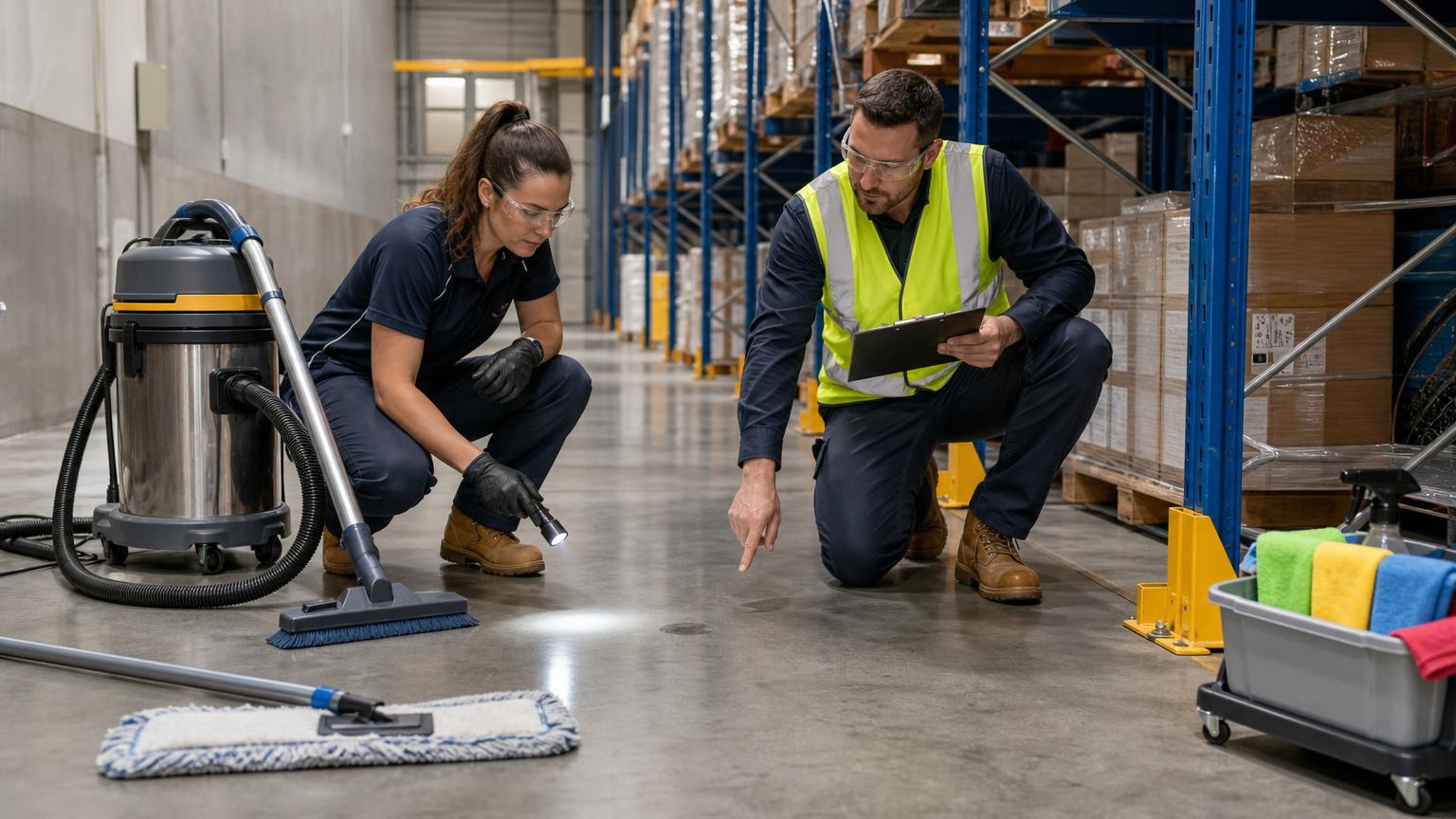
For a warehouse, an example audit could check defined floor zones, traffic routes, accessible racking surfaces and waste points against the agreed scope. The result should state the location and condition found, not simply mark the warehouse clean.